
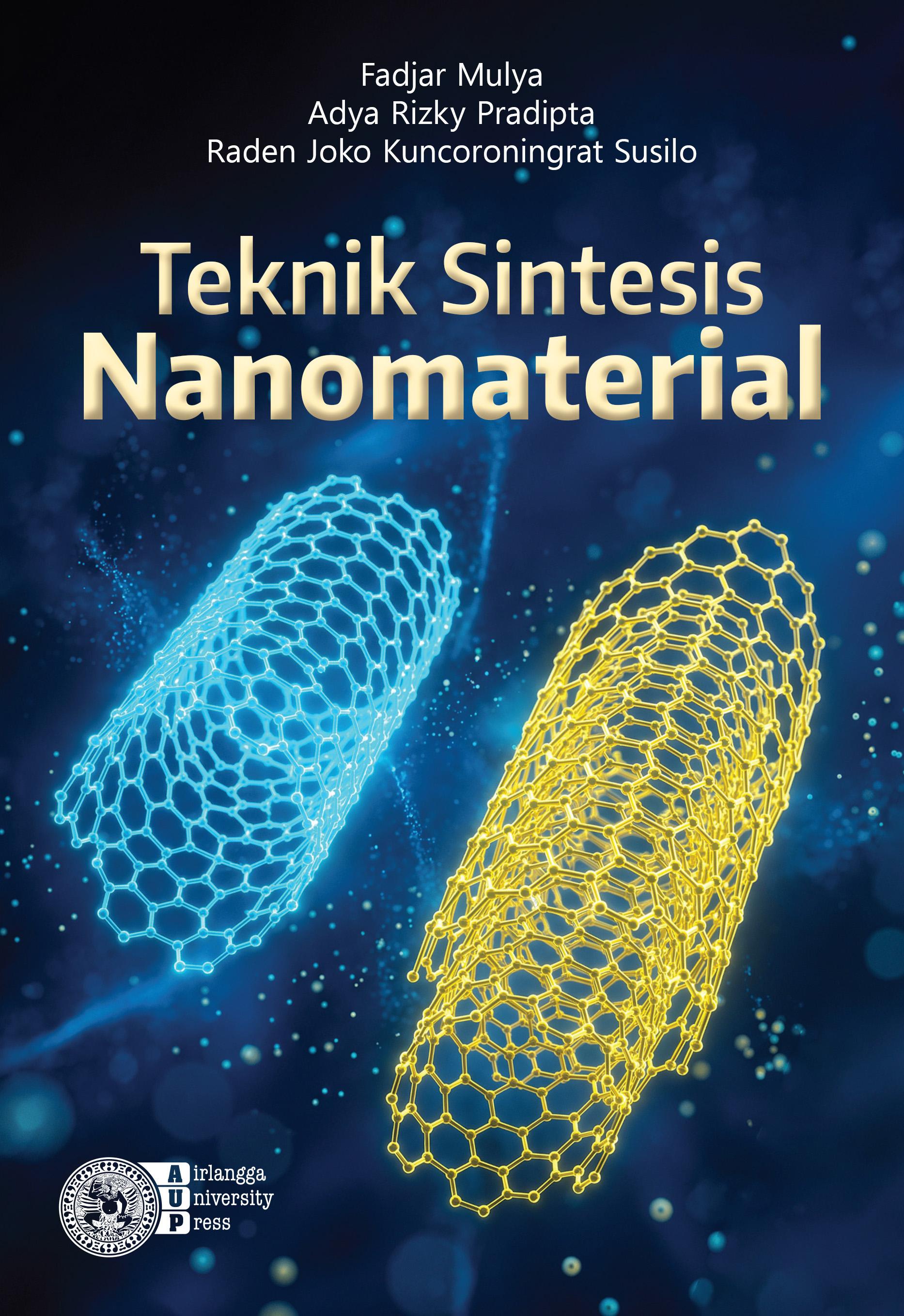
Teknik Sintesis Nanomaterial
Keywords:
nanomaterial, green synthesis, sintesis material, rekayasa materialSynopsis
Perkembangan nanoteknologi abad ke-21 menuntut penguasaan rekayasa materi pada tingkat atomik. Buku Teknik Sintesis Nanomaterial hadir sebagai panduan komprehensif yang menjembatani teori fundamental dengan aplikasi praktis di laboratorium. Secara sistematis, buku ini mengupas kerangka konseptual sintesis sebagai jantung nanoteknologi, meliputi paradigma top-down (pemecahan fisik) dan bottom-up (perakitan molekuler), kinetika nukleasi, hingga kontrol morfologi kristal.
Pembahasan diperkaya dengan eksplorasi material revolusioner, seperti alotrop karbon (graphene, CNT, dan C-dots) serta rute green synthesis berbasis biosintesis (tumbuhan, bakteri, jamur, dan mikroalga). Setiap bab dirancang interaktif berlandaskan Capaian Pembelajaran Mata Kuliah (CPMK), dilengkapi ilustrasi teknis, ringkasan naratif, serta latihan soal analisis.
Disusun oleh akademisi dan peneliti di bidang nanosains, buku ini menjadi referensi wajib bagi mahasiswa sarjana, pascasarjana, serta peneliti lintas disiplin ilmu material, kimia, fisika, dan rekayasa. Lebih dari sekadar kumpulan prosedur, buku ini membekali pembaca dengan pola pikir analitis untuk merancang inovasi nanomaterial yang presisi, biokompatibel, dan selaras dengan prinsip keberlanjutan lingkungan.
Downloads
Download data is not yet available.
References
Anastas, P.T. & Warner, J.C., 1998. Green chemistry: Theory and practice. Oxford: Oxford University Press.
Bard, A.J. & Faulkner, L.R., 2001. Electrochemical methods: Fundamentals and applications. 2nd ed. New York: John Wiley & Sons.
Brinker, C.J. & Scherer, G.W., 1990. Sol–gel science: The physics and chemistry of sol–gel processing. San Diego: Academic Press.
Cao, G. & Wang, Y., 2011. Nanostructures and nanomaterials: Synthesis, properties, and applications. 2nd ed. Singapore: World Scientific.
Dresselhaus, M.S., Dresselhaus, G. & Avouris, P., 2001. Carbon nanotubes: Synthesis, structure, properties, and applications. Berlin: Springer.
Feynman, R.P., 1960. There’s plenty of room at the bottom. Engineering and Science, 23(5), pp. 22–36.
Geim, A.K. & Novoselov, K.S., 2007. The rise of graphene. Nature Materials, 6, pp. 183–191.
Hasanzade, Z. & Raissi, H., 2017. Investigation of graphene-based nanomaterial as nanocarrier for adsorption of paclitaxel anticancer drug: a molecular dynamics simulation study. Journal of Molecular Modeling, 23(2), p. 36.
Iijima, S., 1991. Helical microtubules of graphitic carbon. Nature, 354, pp. 56–58.
Klabunde, K.J. & Richards, R.M. eds., 2009. Nanoscale materials in chemistry. 2nd ed. Hoboken: John Wiley & Sons.
Kochmann, D.M. & Amelang, J.S., 2016. The quasicontinuum method: Theory and applications. In: Multiscale materials modeling for nanomechanics. Cham: Springer International Publishing, pp. 159–193.
LaMer, V.K. & Dinegar, R.H., 1950. Theory, production and mechanism of formation of monodispersed hydrosols. Journal of the American Chemical Society, 72, pp. 4847–4854.
Li, X., Cai, W., An, J., Kim, S., Nah, J., Yang, D., Piner, R.D. & Ruoff, R.S., 2009. Large-area synthesis of high-quality and uniform graphene films on copper foils. Science, 324, pp. 1312–1314.
Mulya, F., 2025. Buku ajar pengantar komputasi untuk perekayasa nanomaterial. Surabaya: Airlangga University Press.
Mulya, F., Kuamit, T., Apilardmongkol, P. & Parasuk, V., 2024. DFT study of lithium adsorption on silicon quantum dots for battery applications. Physica E: Low-dimensional Systems and Nanostructures, 164, p. 116060.
Rungnim, C., Chanajaree, R., Rungrotmongkol, T., Hannongbua, S., Kungwan, N., Wolschann, P. & Parasuk, V., 2016. How strong is the edge effect in the adsorption of anticancer drugs on a graphene cluster? Journal of Molecular Modeling, 22, pp. 1–9.
Schmid, G. ed., 2010. Nanoparticles: From theory to application. 2nd ed. Weinheim: Wiley-VCH.
Shi, S., Gao, J., Liu, Y., Zhao, Y., Wu, Q., Ju, W., Li, H., Huang, X. & Xiao, R., 2016. Multi-scale computation methods: Their applications in lithium-ion battery research and development. Chinese Physics B, 25(1), p. 018212.
Somorjai, G.A. & Li, Y., 2010. Introduction to surface chemistry and catalysis. 2nd ed. Hoboken: Wiley.
Suryanarayana, C., 2001. Mechanical alloying and milling. Progress in Materials Science, 46, pp. 1–184.
Xia, Y., Yang, P., Sun, Y., Wu, Y., Mayers, B., Gates, B., Yin, Y., Kim, F. & Yan, H., 2003. One-dimensional nanostructures: Synthesis, characterization, and applications. Advanced Materials, 15, pp. 353–389.
Yao, N., Chen, X., Fu, Z.H. & Zhang, Q., 2022. Applying classical, ab initio, and machine-learning molecular dynamics simulations to the liquid electrolyte for rechargeable batteries. Chemical Reviews, 122(12), pp. 10970–11021.
Zhang, Q., Uchaker, E., Candelaria, S.L. & Cao, G., 2013. Nanomaterials for energy conversion and storage. Chemical Society Reviews, 42, pp. 3127–3171.
Zhou, Y., Sharma, S.K., Peng, Z. & Leblanc, R.M., 2017. Polymers in carbon dots: A review. Polymer, 109, pp. 17–34.
BISAC
- SCI050000 Science / Nanoscience
- TECHNOLOGY & ENGINEERING
Published
September 15, 2026
Series
Categories
Copyright (c) 2026 Airlangga University Press
License

This work is licensed under a Creative Commons Attribution-NonCommercial-ShareAlike 4.0 International License.
Details about the available publication format: Preview
Preview
Co-publisher's ISBN-13 (24)
978-634-7497-97-0 (PDF)